Evan's Lynnman Warehouse Arson
The Reincarnationist PapersEvan Michaels’s arson of the Lynnman Warehouse is both a carefully prepared crime and a vivid expression of his fixation on fire. Commissioned by Martin Shelby to make the blaze look accidental, Evan methodically alters the warehouse and stages its contents before setting the floor alight. The act brings together practical calculation and Evan’s more personal vision of fire as a force that consumes, reveals, and returns the past.
Commission and Target
Martin Shelby makes the essential condition of the job clear: the fire must look like an accident. Evan asks whether there is anything else he needs to know, but Martin’s instruction establishes the central constraint. The task is not simply to start a fire; its appearance must disguise that someone deliberately set it. The conversation frames the warehouse as a planned target rather than an impulsive choice.
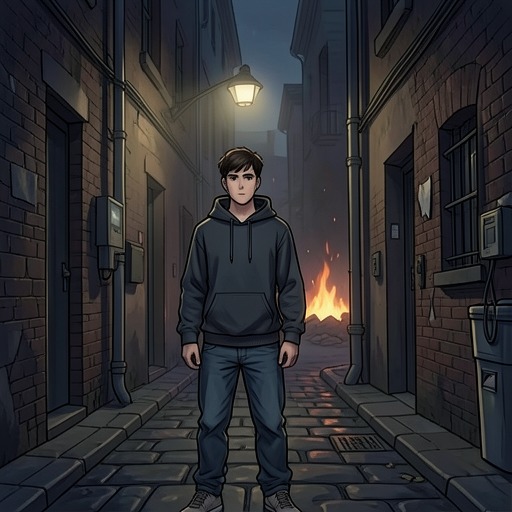
Evan’s later inspection shows the building in a neighborhood marked by neglect. Garbage and broken glass cover the sidewalks, and only one in four or five buildings seems occupied. The warehouse itself is a gray-painted, two-story brick structure. Four tall, narrow windows remain unbroken along the street-facing upper floor, while two larger windows have been boarded over with plywood weathered to the same gray as the building. An isolated floodlight at an occupied warehouse farther down the alley casts shadows behind the target.
The rear entrance is especially conspicuous: a four-foot-wide, eight-foot-high metal door reinforced with horizontal riveted steel straps. Evan thinks it looks more suited to a prison than a warehouse. His attention to this heavy entrance, the boarded windows, and the sparse neighborhood establishes a setting in which access and visibility matter to his preparations.
Entry and Preparation
Evan takes precautions even before entering. He picks up a discarded newspaper and folds it around the contours of his left hand, using it to avoid leaving fingerprints on the iron door handle while he unlocks the dead bolt. The key turns easily and silently. The quiet entry contrasts with the fire he is preparing: at this stage, the work depends on concealment and control.
On a later visit, Evan applies methanol to the second-floor floorboards with a roller pan and mop head. He works in thin coats, beginning in the front corner opposite the stairs. The thirsty wood absorbs the liquid quickly, and he makes longer strokes near the uncurtained windows to keep away from them. His first coat ends along an imaginary diagonal line between the far wall’s last window and the top of the stairs. Three of the original gallons remain when he finishes that pass.
He coats the unfinished vertical support beams next, applying two coats to each. The labor is physical and deliberate: his shirt is soaked with sweat, the alcohol smell hangs in the stagnant air, and the upstairs heat is stifling. When he hears a car in the alley, his attention snaps to the back window. It is Henry’s white truck, and Evan calculates that he has an hour left. The interruption brings the limited time of the operation into sharp focus without displacing its methodical character.
Staging an Accident
When Evan returns at night, he approaches from a bus stop ten blocks away, carrying four medium-sized stones he has picked up along the route. The alley light is still on, dim enough that he uses it to find the key. He puts on gloves, removes his backpack, and steps inside, where a faint smell of solvents drifts down from the second floor. The details extend his preparations beyond the accelerant: he is managing his approach, his contact with the building, and the objects left behind.
At the stairs, Evan takes out two packs of generic cigarettes. He lights six at once and sets them beside a lighter on the fourth step, arranging their burning ends so they can continue to burn. He puts one cigarette in his mouth, then throws a wine bottle and a gin bottle onto the concrete floor of the back room. The wine bottle breaks; the gin bottle bounces and comes to rest beside the bathroom door. These objects create the appearance of disorder, but their placement is purposeful. Evan describes the arrangement in his thoughts as perfectly random: chance itself is something he is constructing for the scene.
Ignition and Significance
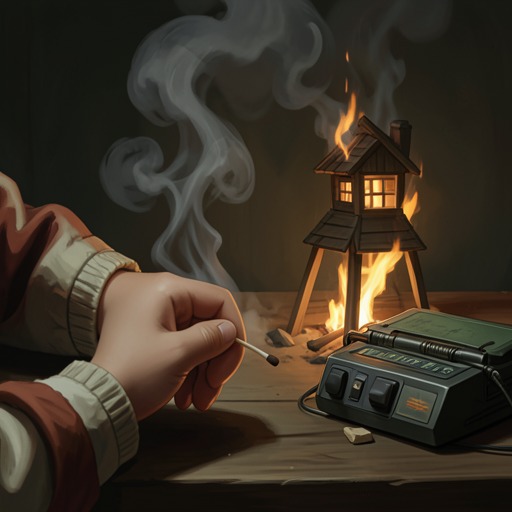
The fire begins with a narrow trail of vodka on the floor. Evan brings his lighter close, watching the small flame leap from it to the wet line. The fire runs along the strip, reaches a larger puddle, and flashes blue across the second floor. From there it creeps beyond the vodka onto the methanol- and wax-coated boards. Its color changes from blue to light orange as it catches the accelerants, then it reaches a central support post and climbs the wood.
Evan watches this progression as more than a practical result. He imagines the flame as a living presence, first a small sprite and then a monster that can move through the room. This language gives the ignition a double force: he has arranged the materials and chosen the moment, yet the spreading fire appears to acquire its own momentum once it reaches the soaked boards and timber. The warehouse’s ordinary surfaces become active parts of the event, carrying the flame from a thin line to the structure itself.
That sense of fire as a summons connects the arson to Evan’s recurring memories of earlier lives and earlier fires. He recalls burning a barn during his last night in Minnesota, and later identifies a powerful memory of Bobby Lynn Murray as one that continues to intrude on his present life and demand satisfaction. The warehouse fire therefore sits between deliberate staging and compulsion: Evan controls its setup, but understands its attraction through a past that keeps returning. Its apparent randomness is manufactured; its deeper recurrence, in Evan’s account, is not.